
Like others, I have been struck by the responsibility of museums and archaeologists, mainly their responsibility over their possession of artifacts. Like we have talked about before, not every civilization with archaeological remains is a dead civilization. (On a side note I cannot say civilization without thinking of our discussion last week. There really needs to be a decolonialization of language, but that is a different, but still very important, discussion.) We have talked about the problems with Native American artifacts being displayed in museums, as the buildings themselves imply that the civilization is gone, when they are still around to this day.
There is a consistent problematic history surrounding museums and their displaying of other culture’s archaeological remains. I’m going to be pointing fingers at England, but that is because they are an easy target. This by no means is meant to imply that they are the only country that has done this. Colonialization comes with a stealing of another civilization’s heritage. (I noticed that Afra has done a great post this week on colonialization in the textbook.) Specifically pointing fingers at England, I’m going to talk some about the Parthenon marbles, otherwise known as the Elgin marbles.
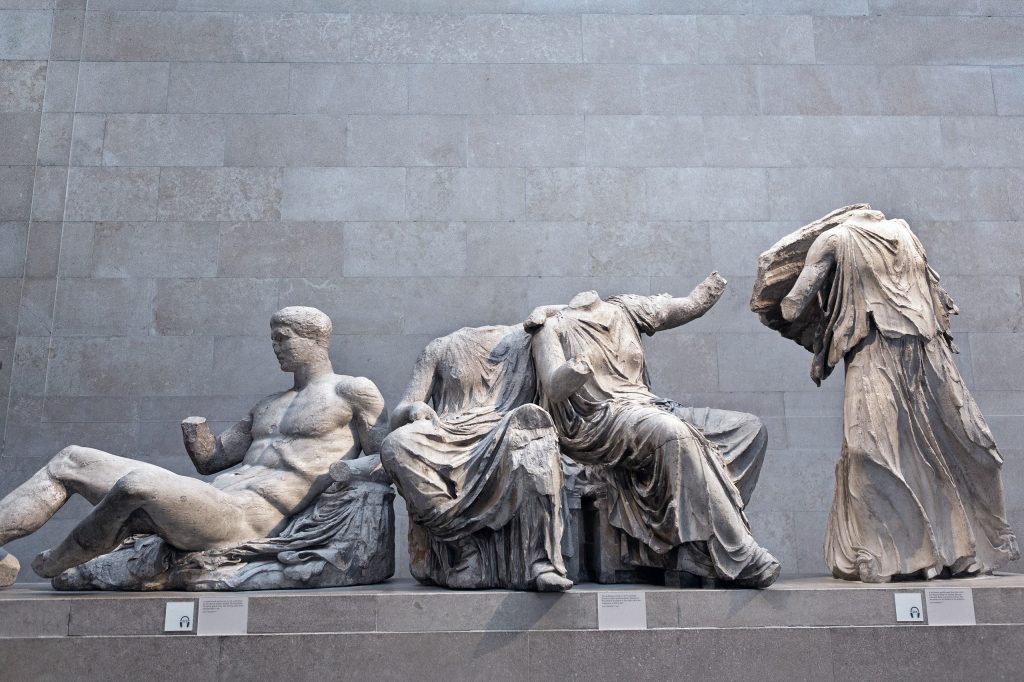
The Elgin Marbles. Named after Thomas Bruce, the 7th Earl of Elgin, who, starting in 1801, removed a number of the sculptures that lined the Parthenon and sent them back to England, where they eventually given to the British Museum, where they remain to this day.
We are going to ignore for the moment, though it is absolutely an important discussion to have, the idolization of Ancient Greece and Athens. For now, we are instead going to focus on the fact that, regardless of their questionable provenance (Elgin claims he received permission from the Ottoman Empire, who controlled Greece at the time. There is some question of this), or the argument that Elgin saved them from being stolen or destroyed (the building was partially destroyed in the 1700s), Greece has asked for the marbles back on a number of occasions. The EU has asked for England to return them. Just this week members of the US congress asked the marbles’ return. Greece is not in any sort of civil war that may pose a concern for the safety of the marbles. The Acropolis museum in Athens, which has a view to the actual Parthenon, as well has having been set up to mirror the Acropolis, has spaces laid out for the marbles. But currently there are only plaster casts. The British Museum, which currently houses the marbles, said in a statement: “The Trustees of the British Museum believe that there’s a great public benefit to seeing the sculptures within the context of the world collection of the British Museum…” (Parthenon Sculptures). But wouldn’t the best context for the pieces be where you can literally see where they once were?
Bringing this back around to other museums, I have to ask, what give the “right” to own history? Why is it that, in it’s own words, the British Museum is “…the most generous lender in the world,” (Parthenon Sculptures). Which is great. However, it also means that they are in possession of numerous artifacts. How many of those are from Britain? Are they loaning out artifacts to their native countries? Why are those countries having to ask for permission to engage in their own history? I know there are numerous problems, and also a number of advantages, in having museums. But I think the fact that there are artifacts that have been taken from their homes, especially when that civilization is still alive in one form or another, is a huge problem that needs to change.
Sources Cited
Norris, Mary. “Should the Parthenon Marbles Be Returned to Greece?” The New Yorker, The New Yorker, 22 Nov. 2019, www.newyorker.com/culture/cultural-comment/should-the-parthenon-marbles-be-returned-to-greece.
“Parthenon Sculptures – the Trustees’ Statement.” The British Museum, www.britishmuseum.org/about-us/british-museum-story/objects-news/parthenon-sculptures/parthenon-sculptures-trustees.
 Transgression In Action
Dear James,
You bring up some really interesting points about the British Museum which, I too, have been thinking a lot about. I was able to travel to Greece last summer and visit the Acropolis museum, and that was probably the first time I really started questioning the ethics of what artifacts museums have in their possession. The museum has an absolutely remarkable design and location with the ability to see the Acropolis out the window and experience the scale to which the marbles were laid out on the temple. Seeing the amount of care and detail that was put into creating this museum really illuminated how wrong it is for the British Museum to still own these pieces. And certainly, this is probably one of the most famous examples, but as we have seen through class this semester, there are so many more. I feel as though now that I have opened this door into the ethics behind all of these issues, there is going to be absolutely no way for me to close it!
Best,
Rachel
LikeLike
Rachel,
I was also able to go visit the museum last summer and was similarly struck by it. Additionally, while looking at the British Museum website, I came across the line “Both museums together allow the fullest appreciation of the meaning and importance of the Parthenon sculptures…” which really just struck me as sort of infantilizing. The Acropolis museum has the casts, yes, but they are a constant reminder that they don’t have the originals. And if I remember correctly, there are some originals that couldn’t be plastered. If they switched places, i.e. giving the British museum the casts, I doubt they would be so enthused over them and willing to say that the casts allowed for the fullest appreciation.
Bit of a rant but the British Museum’s steadfast resistance to returning the marbles really annoys me.
James
LikeLike
Did y’all read about how Greece got the EU to demand the return of these objects as part of England’s post-Brexit trade deal? I’m not sure where things stand with that right now…. but I’m very intrigued to track whether this angle will get any traction.
LikeLike
I remember hearing about that. It was an amazing way to force Britain’s hand. However given that just this past week US members of congress sent a request that the marbles be returned, I don’t think that the Brexit trade deal thing went through. But I’ll also admit that I haven’t been paying that much attention to Brexit.
LikeLike
Hi James,
Thanks for the shoutout! I really enjoyed reading your thoughts on museums and the ownership of artifacts, as well as the specific example you highlighted. Kind of off-topic, but whenever I hear about the British and their blatant looting of other people’s things I think back to when one artist took a small piece of Scafell Pike’s peak, prompting the British tourism industry to demand it back under the cry that they were being “stolen from” (so absolutely ironic of the British lol). Anyways I was very intrigued to read about the case of the Elgin Marbles, especially since I’m definitely don’t know as much about the legal issues and debates surrounding museum ownership as I’d like to. I do think it’s ironic and of course a little saddening that the British Museum calls itself the “most generous lender in the world,” when the items they are just lending out the objects that they stole back to their original owners… it feels like a way of asserting dominance and ownership under a mask of generosity which I simply do not like. Excited for the posts to come,
Best,
Afra
LikeLike