The Rise and Rediscovery of Mesa Verde

Mesa Verde is a national park and UNESCO World Heritage Site located in southwestern Colorado.  Best known for the numerous cliff dwellings dotting the sides of the mesa, it was originally established as a national park by Congress and President Theodore Roosevelt in 1906, with the park occupying 52,485 acres and, with more than 5,000 sites, is the largest archaeological preserve in the United States (Mesa Verde National Park).  However, Mesa Verde has a rich history long before it became a national park.  Even its establishment as a park has its own story. 
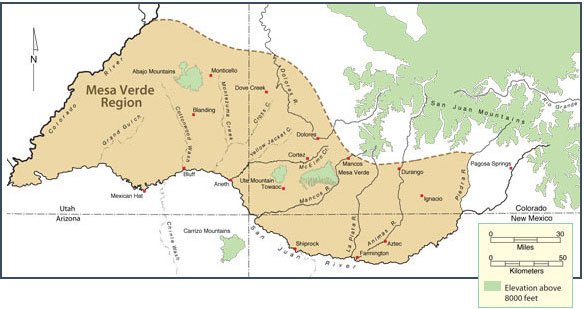
Map of the Mesa Verde Region (Morris) 

Occupation of the Mesa Verde region can be traced back thousands of years.   It was primarily a hunter-gatherer society until around 2200 BC, when there is evidence of the first known domestication of corn in the region.  Though the people at the time were still practicing the Archaic hunter-gatherer lifestyle, the domestication of corn is a clear sign of a shift towards an agricultural based society. 

It is generally agreed that shift from hunter-gatherer to a primarily agricultural lifestyle, marking the beginning of Puebloan culture in Mesa Verde, was between 500 and 400 BC.  The shift includes the creation of more permanent dwellings.  These structures, not cliff dwellings, were pithouses – semisubterranean structures that served as houses for individual families.  This group, called Basketmaker II, lasted until around 500 AD, which was followed by the Basketmaker III group.  This group included numerous advancements, including the development of great kivas and roomblocks – above ground, contiguous storage rooms – new pottery technics, notably grey and white ware and red ware, and the domestication of new crops, such as cotton. 

The first Pueblo villages, defined as settlements with more than 50 rooms, began appearing around the mid 8th century AD and marks the start of the Pueblo I period.  There was a dramatic shift in architecture, as the first masonry style – stones stacked vertically and held in place by mortar –  constructions began appearing, as well as the shift from pithouses to kivas as the primary focal point for household activities.  Pueblo II, which began around 900 AD, saw the growth of trade networks, especially through Chaco Canyon, a major cultural and economic hub of the Ancestral Puebloan world in modern day northwestern New Mexico.  Finally, we have reached Pueblo III, which is generally defined as 1150 to 1300 AD.  Almost two hundred years after its grand rise to prominence, Chaco Canyon, and the rest of the Four Corners region, experienced the longest and most severe drought in the region’s history, causing a rapid waning of Chaco’s influence as people migrated away.  A number of these people traveled to Mesa Verde, where, in 1250 AD, they hit their population peak.  It wouldn’t last, however, as drought, temperature change, and warfare all led to a mass migration and the decline of Mesa Verde, with the region being almost completely deserted by the end of the 13th century.  The Pueblo III period is curiously short, lasting only 150 years, but also saw the building of the cliff dwellings, an impressive feat, only for them to be abandoned shortly thereafter.   
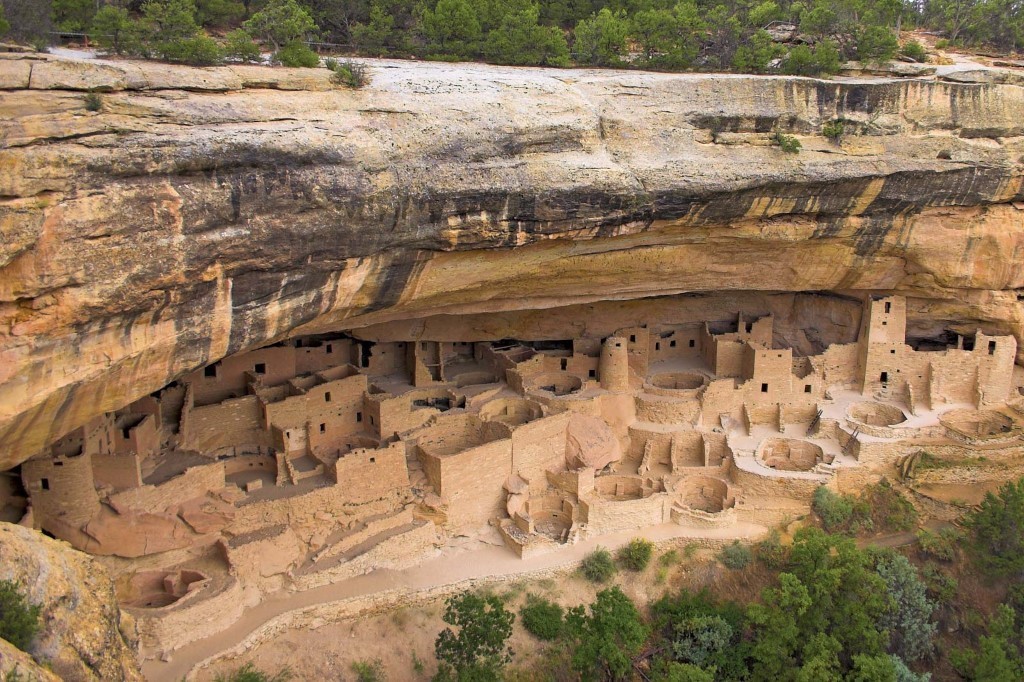
Cliff Palace (Watkins) 

After the mass migration away from Mesa Verde in the 13th century, the cliff dwellings of Mesa Verde sat empty for hundreds of years.  The Ute tribe, who lived in western Colorado since at least the 1400s, did not settle in the empty houses.  In describing the dwellings to Richard Wetherill, a rancher, one member of the local Ute tribe said, “Deep in that canyon and near its head are many houses of the old people – the Ancient Ones. One of those houses, high, high in the rocks, is bigger than all the others. Utes never go there, it is a sacred place,” (Wenger 79).  Over the years, Mesa Verde was visited by various explorers and pioneers, even gaining its name from two Mexican-Spanish missionaries seeking a route from Santa Fe to California in 1776, who recorded their travels and named the region after the tree-covered plateaus, though they never got close enough to see the cliff dwellings.  The land of Mesa Verde, and all of the Colorado land west of the Continental Divide, was formally recognized as belonging to the Ute tribe by the United States in a 1868 treaty.  However, only a few years later in 1873, the US government changed the agreement, giving the Ute tribe a strip of land in southwestern Colorado that contained most of Mesa Verde.  Both treaties were caused by gold and silver being found in the Rocky Mountains, with gold and silver later being found on the western side of the Rockies causing the second treaty. 

Though it is unclear who first “discovered” Mesa Verde, it was William Henry Jackson who first recorded the cliff dwellings on film.  In 1874, he photographed a number of cliff dwellings and even gathered some pottery pieces, which he sent to the National Museum.  Afterwards, a number of other people, including geologist William H. Holmes, and journalist Virginia McClurg, visited the dwellings.  However, it wasn’t until Richard Wetherill came along in 1888 that exploration of the sites really began. 
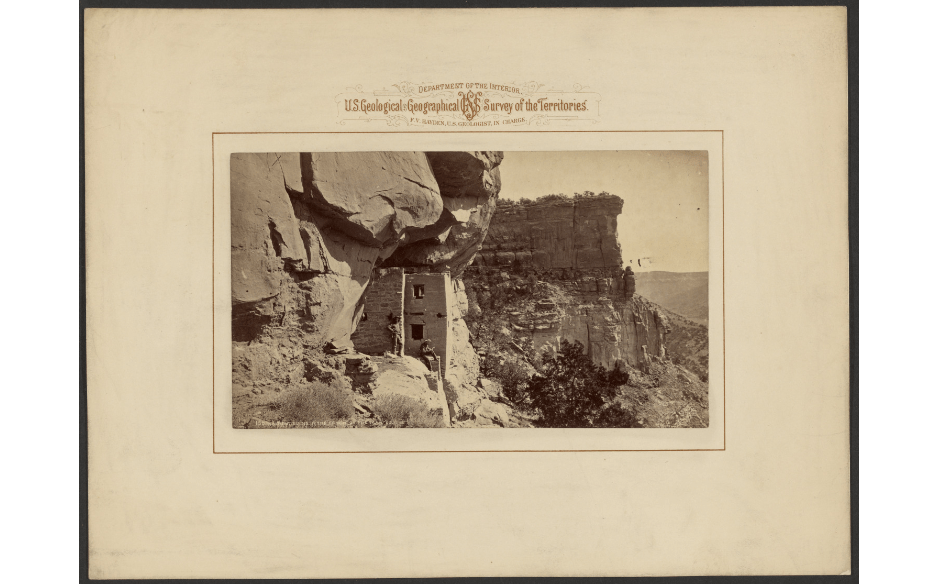
Ancient Ruins in the Cañon of the Mancos (Jackson) 

Richard Wetherill was a rancher in Mancos, Colorado, and his family had set up an agreement with the nearby Ute tribe, which allowed them to bring their cattle onto the tribe’s land.  While there, they found a number of smaller cliff dwellings.  On December 18, 1888, Richard Wetherill and Charles Mason, a fellow rancher, spotted the large dwelling that Wetherill later named Cliff Palace.  The same day, Wetherill also managed to find Spruce Tree House, and the next day Square Tower House.  All of these dwellings, as well as the names of the mesas themselves, Wetherill and Chaplin, remain their names today.  For years, the Wetherills, as well and their friends and neighbors, collected and sold thousands of artifacts from the ruins, with most of them ending up in museums. 

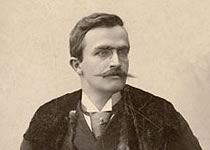
The Wetherills’ rough exploration and excavation continued until in 1891, Gustaf Nordenskiöld came.  Nordenskiöld was a Swedish mineralogist visiting the States in an attempt to ease his tuberculosis.  However his tour was cut short when he heard of the number of cliff dwellings in Mesa Verde and, upon seeing them himself, decided to settle in Colorado for a time to research and document the ruins.  Nordenskiöld, with his background in minerology, actually brought a degree of scientific method to the proceedings, and conducted the first archaeological excavation of the cliff dwellings.  However, along with the over 150 of pictures that he took during his time in Mesa Verde, Nordenskiöld also took hundreds of artifacts from the sites.  At this time, there were no laws in Colorado against treasure hunting, so Nordenskiöld was legally allowed to do so.  However, his looting of so many artifacts caused an uproar, which ended with him even being arrested, although Nordenskiöld was far the only person looting the ruins.  The Wetherills had been doing so for years now and, as knowledge and interest in the dwellings spread, so too did people coming to tour the area, many of whom took artifacts from the sites as trophies.  Needless to say, xenophobia played a role in Nordenskiöld’s arrest, though he was eventually released as he had not committed an actual crime.   
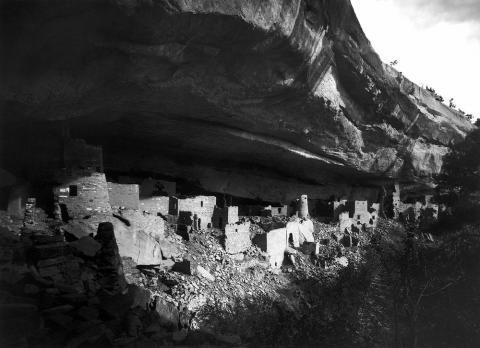
Cliff Palace (Nordenskiöld) 

Nordenskiöld soon returned to Sweden, where he wrote a book on the cliff dwellings, The Cliff Dwellers of Mesa Verde, Southwestern Colorado: Their Pottery and Implements, while the artifacts he shipped back to Sweden were bought by a Finnish collector after Nordenskiöld’s death, who eventually donated them to the University of Helsinki.  They later moved to the National Museum of Finland, where they resided until very recently.  It was announced in a meeting in October 2019, though the actual process had been prepared for years, between Finland President Sauli Niinistö and US President Trump that the National Museum would be returning the remains and some of the artifacts to Mesa Verde.  Finally, in September 2020, the remains and artifacts promised were returned to Mesa Verde, with the Hopi Tribe in northeastern Arizona, and Zuni, Acoma and Zia pueblos in New Mexico having been involved in the process and have since reburied the remains of about 20 bodies taken from Mesa Verde by Nordenskiöld. 

As for the park itself, efforts were made over the years to get the government to grant federal protection to the area to styme the flood of artifacts from the area.  In a report to the Secretary of the Interior, Smithsonian Ethnologist Jesse Walter Fewkes described the vandalism of Mesa Verde’s Cliff Palace: 

No ruin in the Mesa Verde Park had suffered more from the ravages of “pot hunters” than Cliff Palace; indeed it had been much more mutilated than the other ruins in the park. Parties of workmen had remained at the ruin all winter, and many specimens had been taken from it and sold. There was good evidence that the workmen had wrenched beams from the roofs and floors to use for firewood, so that not a single roof and but few rafters remained in place…Many of the walls had been broken down and their foundations undermined, leaving great rents through them to let in light or to allow passage from the débris thrown in the rooms as dumping places. Hardly a floor had not been dug into, and some of the finest walls had been demolished. All this was done to obtain pottery and other minor antiquities that had a market value. The arrest of this vandalism is fortunate and shows an awakened public sentiment, but it can not repair the irreparable harm that has been done. (Fewkes) 

In order to protect the ruins and artifacts held within, spurred on by the loss of so many artifacts to Sweden by Nordenskiöld, congress passed the Federal Antiquities Act in 1906, and in the same year President Theodore Roosevelt approved the creation of Mesa Verde National Park, becoming the first national park established for its cultural significance (Rancourt). 

Today, over a hundred years after its instatement as a park, Mesa Verde has served its purpose as a protection for the artifacts and archaeological sites within from the worst of the looters.  However, it is important to think about what we can learn from the park’s history and what we can do moving forward.  While the park no longer suffers from the rampant looting that led to Fewkes’ gut-wrenching description of the state of Cliff Palace, there is still a casual form of looting that most look over, even the looters themselves.  Although most of the artifacts within the archaeological sites have been brought to museums for care and study, it is still possible to find the occasional pottery sherd.  In my own visit to the park, while I was walking around one of the more out of the way sites, I found a number of sherds scattered around on the ground where anyone could pick them up.  I’m sure that any number of people who visited that site would see the sherds and take one with them as a souvenir or a way to remember their trip.  However, this severely damages the archaeological record and is, at its heart, still looting.  But most people would not think of it that way, as they have never been told otherwise.  I think it is important for there to be information around, such as in the museum, that discusses the damage of looting, as well as signs near sites.  While this may not stop the most determined or oblivious person, it will serve as education for the wider population, who may not know that taking artifacts, even artifacts as small and seemingly insignificant as pottery sherds, is harmful.  Overall, I believe that by educating people on the history of Mesa Verde can impress upon them the importance of archaeology, history, and understanding not to take any artifacts they may find on the ground when they visit these sites. 

Works Cited 

Fewkes, Jesse Walter. “Antiquities of the Mesa Verde National Park Cliff Palace.” Antiquities of the Mesa Verde National Park: Cliff Palace, by Jesse Walter Fewkes – A Project Gutenberg EBook., www.gutenberg.org/files/42266/42266-h/42266-h.htm

“Mesa Verde National Park | World Heritage Site | Discover a place that time has forgotten” (PDF). Visitmesaverde.com 

Rancourt, Linda M. “Cultural Celebration.” National Parks, vol. 80, no. 1, Winter 2006, p. 4. EBSCOhost, search.ebscohost.com/login.aspx?direct=true&AuthType=sso&db=aph&AN=19505113&site=ehost-live&scope=site. 

Wenger, Gilbert R, and David W Wilson. The Story of Mesa Verde National Park. Fourth rev. print ed., Mesa Verde Museum Assoc, 1999. 

Images Used 

Jackson, William Henry. Ancient Ruins in the Cañon of the Mancos. 1874. 

Morris, Neil. “Map of the Mesa Verde Region.” Crow Canyon Archaeological Center, 2014 Peoples of the Mesa Verde Region [https://www.crowcanyon.org/EducationProducts/peoples_mesa_verde/intro.asp]. 

Nordenskiöld, Gustaf. “Cliff Palace in Mesa Verde, Southwestern Colorado.” Gustaf Nordenskiöld and the Mesa Verde Region, Colorado Encyclopedia, 20 Aug. 2015, coloradoencyclopedia.org/article/gustaf-nordenski%C3%B6ld-and-mesa-verde-region. 

Watkins, David. Cliff Dwellings: Cliff Palace. Mesa Verde National Park. 
A Blast from the Past

For my final project, I’m going to be looking at Mesa Verde, specifically trying to trace the cataloguing of the cliff dwellings and artifacts found within by Gustaf Nordenskiöld.  A mineralogist by training, Nordenskiöld was a part of the first concerted effort to explore the cliff dwellings after decades of the occasional explorer visiting.  As a part of his cataloguing, Nordenskiöld shipped a large number of artifacts back to Sweden, where they eventually made their way to the National Museum of Finland.  Given what we have learned, I am curious to know the fate of the artifacts shipped out of the country, any issues that have been raised by said transfer, and what occurred in Mesa Verde after Nordenskiöld.

“INTERLUDE: History of the Antiquities Act and Background on the Federal Lands Transfer Movement.” Voices from Bears Ears: Seeking Common Ground on Sacred Land, by REBECCA M. ROBINSON et al., University of Arizona Press, TUCSON, 2018, pp. 95–99. JSTORwww.jstor.org/stable/j.ctv6zdc76.15. Accessed 19 Oct. 2020. 

This article talks about the Antiquities Act, enacted in 1906, which allows the president to declare sites national monuments.  This was done to curtail looting, incentivized in part by Nordenskiöld’s brazen looting of Mesa Verde.  The article continues to explain the history of the act through to almost present day. 

Lister, Robert H. “Archeology for Layman and Scientist at Mesa Verde.” Science, vol. 160, no. 3827, 1968, pp. 489–496. JSTORwww.jstor.org/stable/1723952. Accessed 19 Oct. 2020. 

An article from the May 1968 Science publication, this piece goes into a lot of the detail of Mesa Verde’s history and what is known about the ancestral Puebloans.  Although it does suffer some from when it was published, using outdated terminology and having less advanced archaeological technics, it does provide a decent overview of the park’s history and a focus on what archaeological knowledge they had at the time. 

“Losing Their Identity: National Park Service Museums and Federal Collections.” Museums, Monuments, and National Parks: Toward a New Genealogy of Public History, by Denise D. Meringolo, University of Massachusetts Press, 2012, pp. 59–83. JSTORwww.jstor.org/stable/j.ctt5vk1kt.7. Accessed 19 Oct. 2020. 

A chapter of a book on museums, monuments, and national parks as a whole, this part brings to life some of Mesa Verde’s early history as a park, including detailing the extreme mismanagement of the park early on.  As a side note, it includes how influential anthropologist Franz Boas in 1905 left his job at the American Museum of National History and two years later wrote a piece on how museums are problematic and oversimplify human history, as well as organizing stuff on a scale of “savagery” to “civilized.”  This doesn’t necessarily tie into my project, but I thought it was interesting that some of the problems we have been discussing were brought up over a hundred years ago. 

Nordenskiöld Gustaf. The Cliff Dwellers of the Mesa Verde. Mesa Verde Museum Association, 1990. 

The book that Gustaf Nordenskiöld himself wrote about the cliff dwellings and what he found there.  I feel that I’d be remise to not include his own voice in all of this.  Additionally, it may provide some enlightenmnet about him shipping artifacts off to Sweden and their journey afterwards to eventually rest in the National Museum of Finland. 

Nordenskiöld Gustaf, et al. Stones Speak and Waters Sing : The Life and Works of Gustaf Nordenskiold. Mesa Verde Museum Association, 1984. 

Similar to the one above, this book looks at Nordenskiöld’s life as a whole, including his numerous expeditions in Mesa Verde, and talking about the Nordenskiöld collection, as the artifacts he took from the sites became called. 

SELLARS, RICHARD WEST. “A Very Large Array: Early Federal Historic Preservation–The Antiquities Act, Mesa Verde, and the National Park Service Act.” Natural Resources Journal, vol. 47, no. 2, 2007, pp. 267–328. JSTORwww.jstor.org/stable/24889175. Accessed 19 Oct. 2020. 

Similar to the first article, this one talks about the creation of the 1906 Antiquities Act and the subsequent creation of Mesa Verde as a national park.  It goes on to talk about the park’s history and the history of national parks as a whole, with their philosophical and policy foundations. 

The man himself, Gustaf Nordenskiöld

A Ribbiting Experience

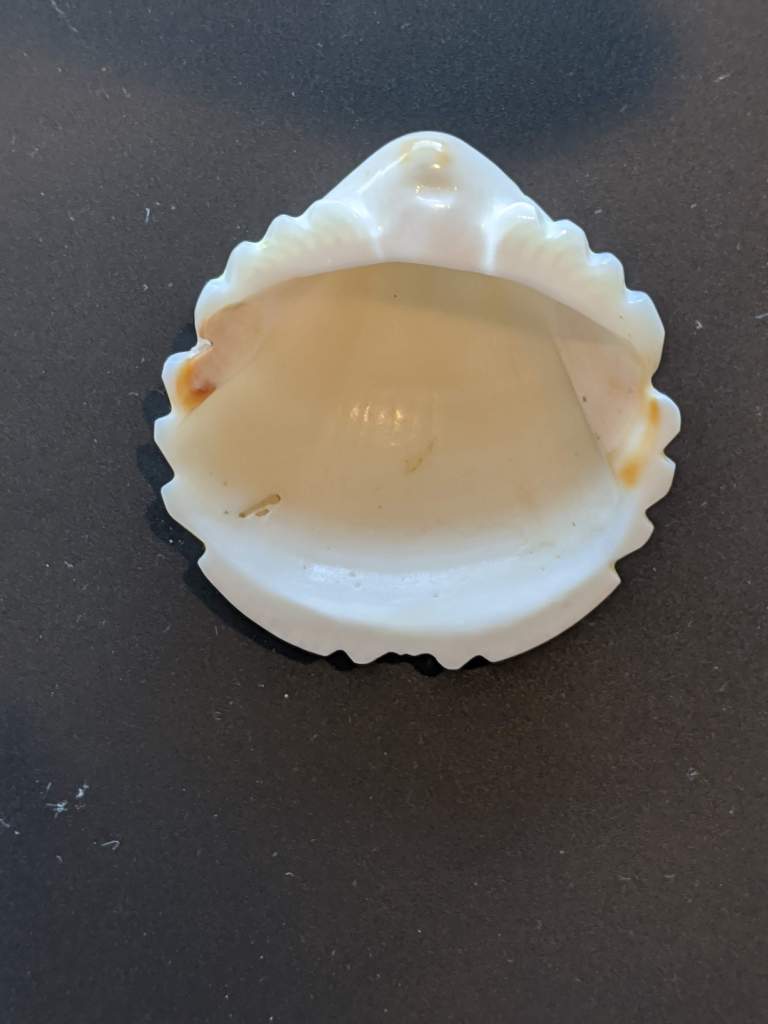
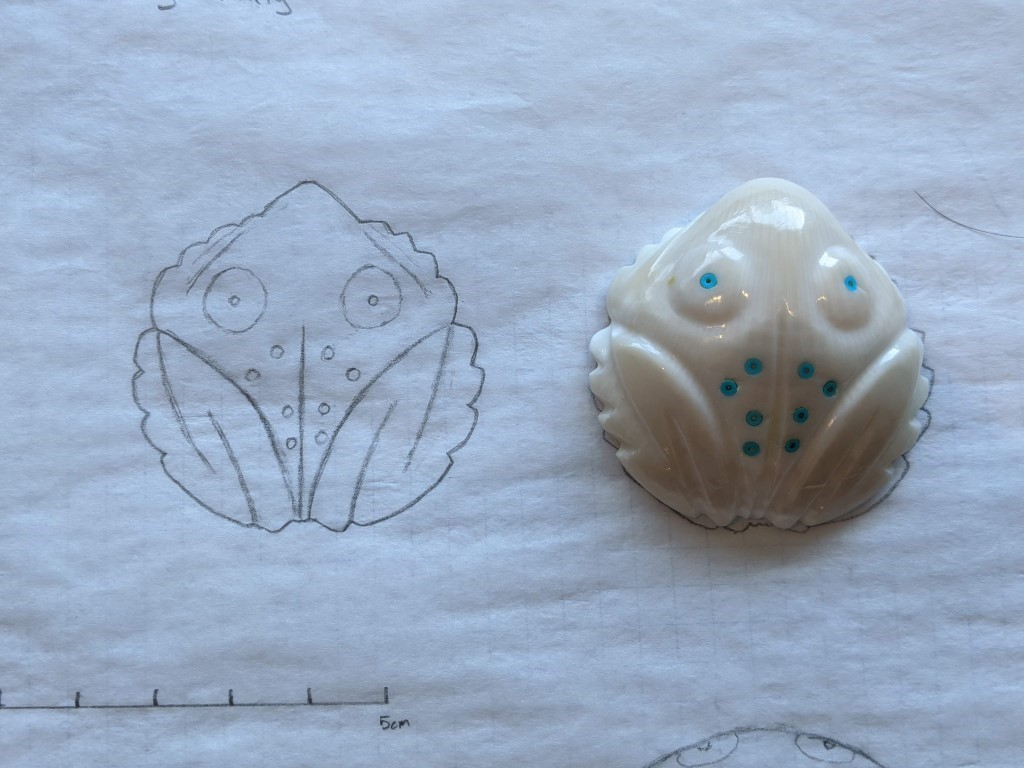
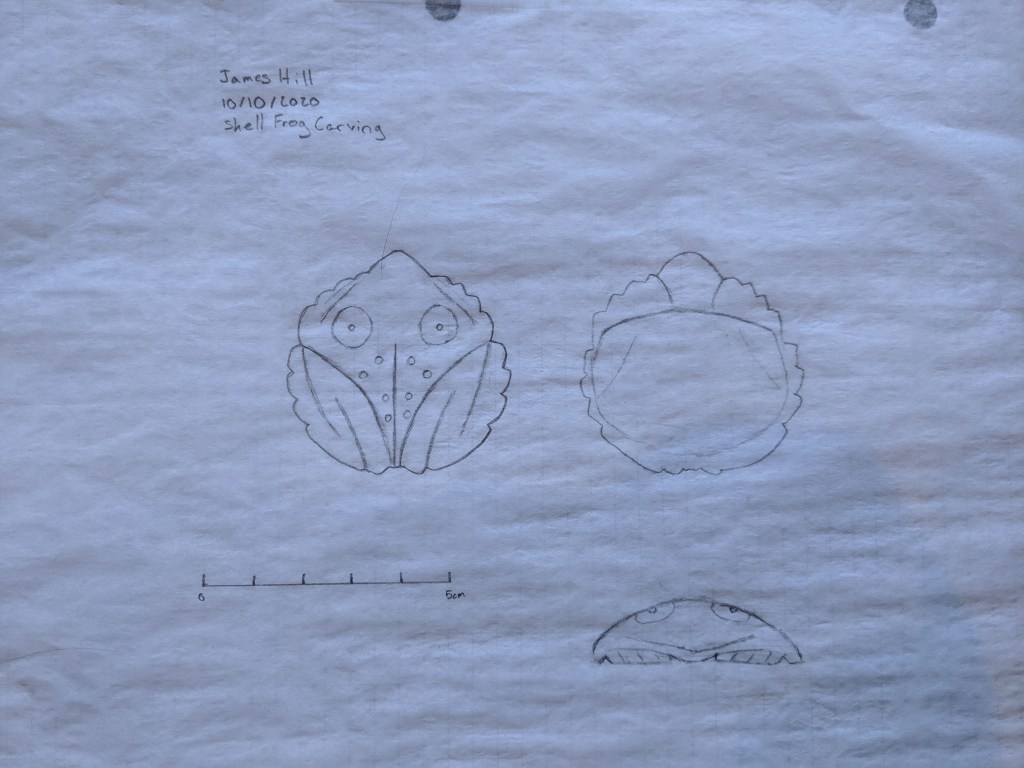
Like the first, I really enjoyed this archaeological drawing.  For my heirloom, I ended up picking out a shell, likely a clam shell, that was carved into the shape of a frog.  I ended up going with this because, while it isn’t as old as some things I could have found, most of the proper heirlooms in the family are jewelry, which I wouldn’t want to scratch up, or really delicate stuff, like a small goat woven out of straw.  The frog came from a trip my parents took to Santa Fe at some point, and is likely Zuni style. 

Shell Frog, Front
Shell Frog, Back

I found, as I continued working on the drawing, that I would look at the frog again and spot a new line, a new detail, that really worked to bring it to life.  After the process, I feel I have a much greater appreciation for the skill and thought that went into the frog.  Which is interesting to think about, because I didn’t have that feeling after working with the mug.  I suppose that is the difference between knowing that something is newer and machine-made vs older and made by hand. 

Two Small Friends

One thing that struck me with this drawing is how artifacts can be a great source of knowledge about a place.  By looking at the materials or technics, one is able to learn a lot about the culture, as well as relationships with other nearby groups.  It is possible to find something, like obsidian or coins, which are highly recognizable, far from their source.  This opens up whole new revelations about contact and trade between one or many different groups for it to have ended up where it did.  In the case of my little frog, it implies that, at some point, either I or someone I know, in this case my family, had had contact with someone in the Santa Fe region. 

What the Looting?!

My heart broke when I heard that Schliemann carved his way through Troy with TNT.  So much knowledge was lost, all so one man could gain academic approval and monetary gain.  That being said, I don’t blame Schliemann too much.  Early archaeology kills me.  It was little better than looting.  Excavation of Pompeii began in 1748 and I can’t help but wonder how much has been lost because of that.  1748.  That was before Jefferson had his little “archaeology” endeavor, disrupting Native American graves.  The saving grace for Pompeii is that it is enormous.  Even today, only two thirds of the city have been uncovered.  This means that, as science progresses, new tools and methods are developed that can tell us things that we would not have been able to know before.  And this only works because there are still parts of Pompeii that remain undisturbed.  But there is no such luck for Troy.  Like Sophie said, any information from the Great Trench now lays in a mess pile off to the side.  And I have to wonder about other sites.  Sites that were torn apart for their goods.  What knowledge was lost because of that?  And what can we do with the history that has been lost?  I think some processes are already in place.   

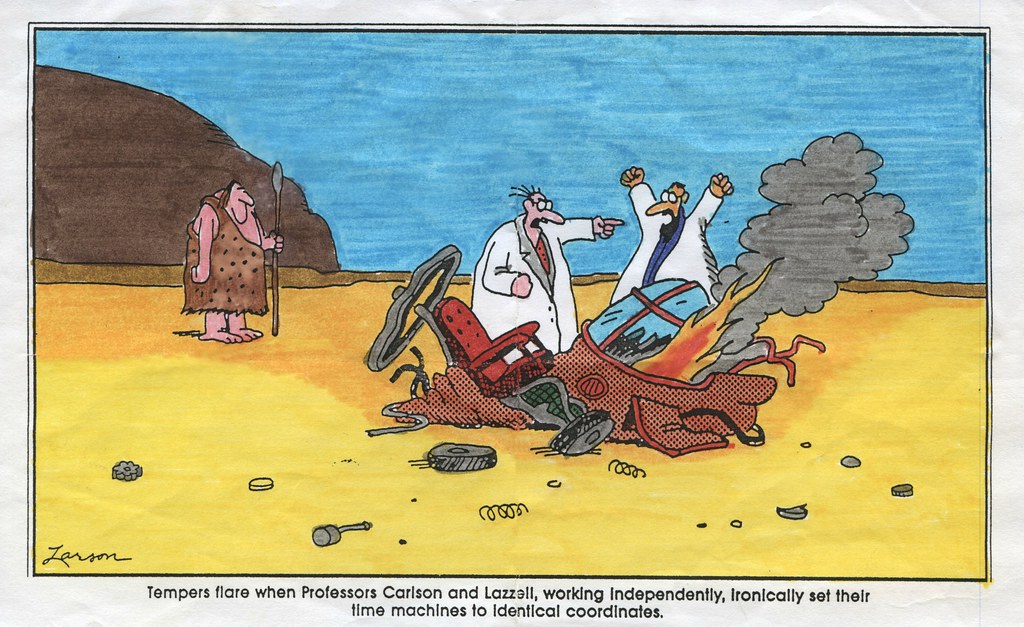
Time travel may not be the best solution to my question

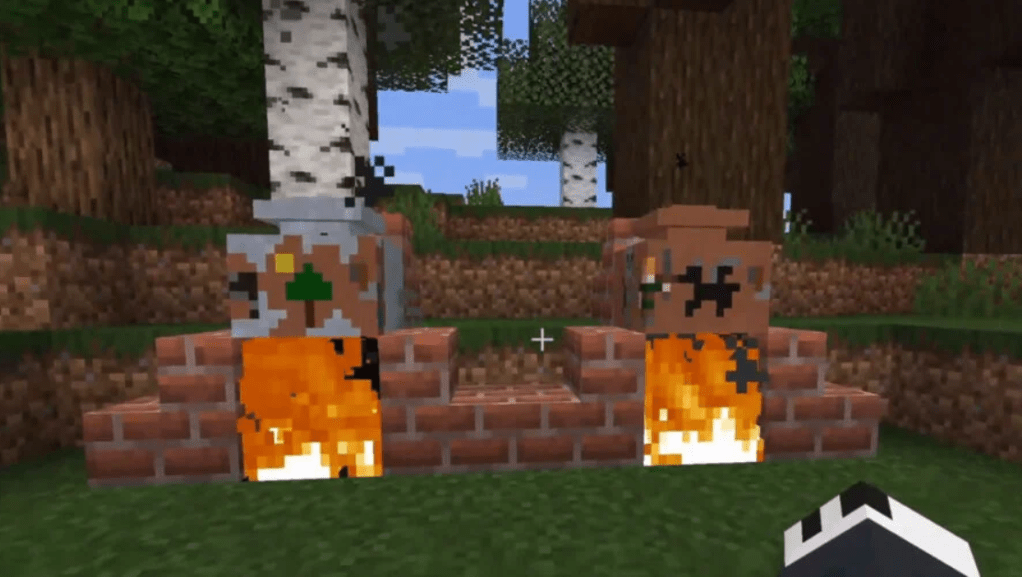
I’m going to change gears wildly here, although I promise it is still related.  Although it isn’t part of the prompt, I have something else I want to touch on.  Archaeology came up for in in a very surprising place this week – In Minecraft.  This weekend, Mojang revealed a lot of info about the next big update for Minecraft.  Although most of the update was about changing the Caves and Mountains, there were a few other things added.  One of those is the inclusion of pre-generated archaeological dig sites.  These sites seem to include some wooden structures over the sites, as well as signs indication the possible function of an area.  The big thing, however, is the ability to use a brush to dig up the sites, which can reveal artifacts.  The artifacts seem to be separated into two categories.  One is ceramic shards, which can be fitted into a pot in any way the player wants and refired.  The other are richetites, such as diamond or emerald blocks.  While the dig sites do seem to come with item frames to display and preserve the finds, I will admit to being somewhat concerned.  The ceramic shards, the more harmless of the two, reminds me of the recreated ceramics that Jody shared with us a few weeks back.  The ones which appeared to be fully restored pieces, but were revealed by tests to be heavily added to.  And the player can arrange the shards any way they want on the pots, which gets concerningly close to manipulating history. 

Refiring ceramic pots

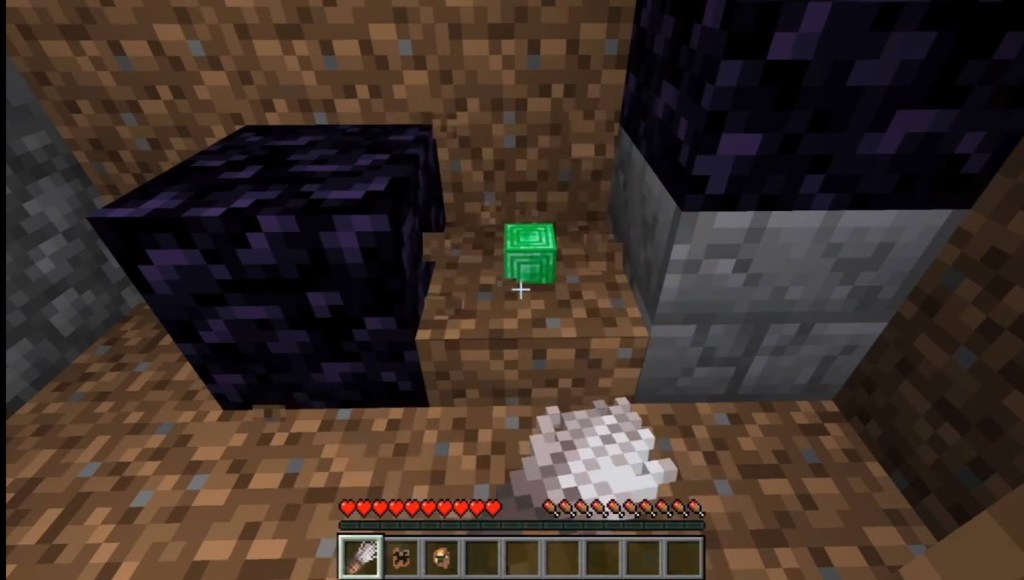
However, to me the second is more concerning.  Say you are the average player.  You find a dig site, go through the slow process of brushing away dirt to find a diamond block.  Are you going to carefully preserve the diamonds?  Or are you going to add them to your own stockpile of richetites?  There is no punishment system in place that might prevent the player from just pocketing the goods.  And in that way, Minecraft is, unintentionally, advocating for the looting of archaeological sites.  This especially strikes hard given what we have read about Schliemann and Priam’s Treasure.  A random person wandering around, finds an archaeological site, and decides to start rummaging around to see what they can find.  While the Minecraft system does emphasize slow, methodical work, with artifacts breaking if you attempt to dig through the block carelessly, so you couldn’t just TNT your way through like Schliemann, it does offer the players the easiest diamond block they’ve ever gotten with no system in place to question the morality of what they are doing.  So, while it is exciting to see Minecraft exposing people to archaeology, the lack of restrictions is concerning, to say the least, and are reminiscent of archaeological looting practices. 

Easiest Emeralds Ever

The Most Generous Lender in the World

Like others, I have been struck by the responsibility of museums and archaeologists, mainly their responsibility over their possession of artifacts.  Like we have talked about before, not every civilization with archaeological remains is a dead civilization. (On a side note I cannot say civilization without thinking of our discussion last week.  There really needs to be a decolonialization of language, but that is a different, but still very important, discussion.)  We have talked about the problems with Native American artifacts being displayed in museums, as the buildings themselves imply that the civilization is gone, when they are still around to this day. 

There is a consistent problematic history surrounding museums and their displaying of other culture’s archaeological remains.  I’m going to be pointing fingers at England, but that is because they are an easy target.  This by no means is meant to imply that they are the only country that has done this.  Colonialization comes with a stealing of another civilization’s heritage.  (I noticed that Afra has done a great post this week on colonialization in the textbook.)  Specifically pointing fingers at England, I’m going to talk some about the Parthenon marbles, otherwise known as the Elgin marbles. 

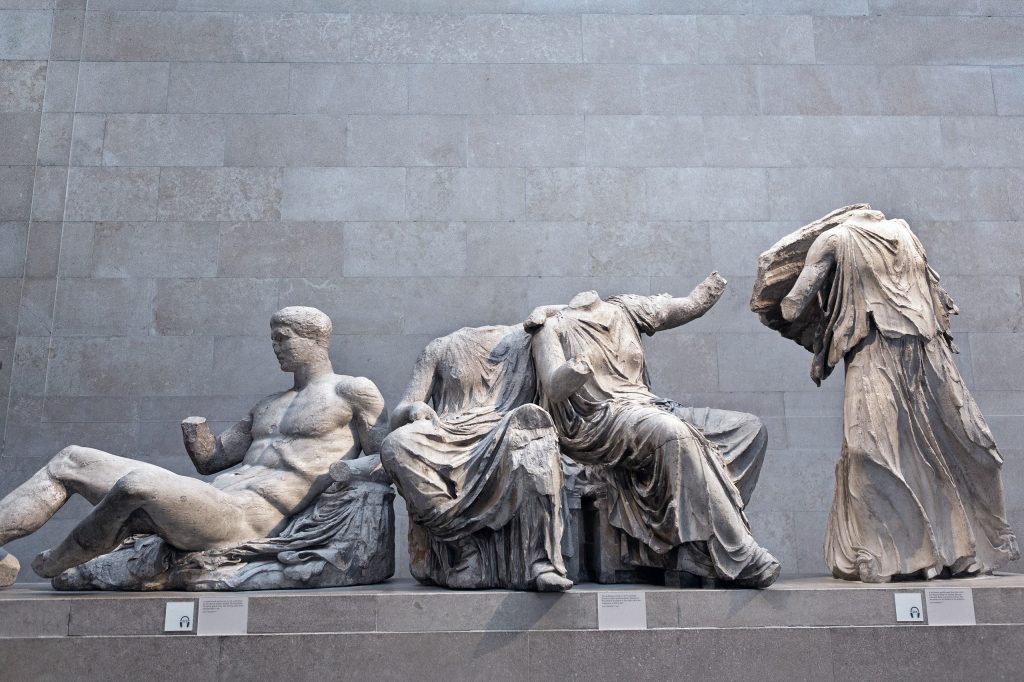
These are bigger than you think.  (Photograph by Tony French/Alamy, Norris) 

The Elgin Marbles.  Named after Thomas Bruce, the 7th Earl of Elgin, who, starting in 1801, removed a number of the sculptures that lined the Parthenon and sent them back to England, where they eventually given to the British Museum, where they remain to this day. 

We are going to ignore for the moment, though it is absolutely an important discussion to have, the idolization of Ancient Greece and Athens.  For now, we are instead going to focus on the fact that, regardless of their questionable provenance (Elgin claims he received permission from the Ottoman Empire, who controlled Greece at the time.  There is some question of this), or the argument that Elgin saved them from being stolen or destroyed (the building was partially destroyed in the 1700s), Greece has asked for the marbles back on a number of occasions.  The EU has asked for England to return them.  Just this week members of the US congress asked the marbles’ return.  Greece is not in any sort of civil war that may pose a concern for the safety of the marbles.  The Acropolis museum in Athens, which has a view to the actual Parthenon, as well has having been set up to mirror the Acropolis, has spaces laid out for the marbles.  But currently there are only plaster casts.  The British Museum, which currently houses the marbles, said in a statement: “The Trustees of the British Museum believe that there’s a great public benefit to seeing the sculptures within the context of the world collection of the British Museum…” (Parthenon Sculptures).  But wouldn’t the best context for the pieces be where you can literally see where they once were?   

Bringing this back around to other museums, I have to ask, what give the “right” to own history?  Why is it that, in it’s own words, the British Museum is “…the most generous lender in the world,” (Parthenon Sculptures).  Which is great.  However, it also means that they are in possession of numerous artifacts.  How many of those are from Britain?  Are they loaning out artifacts to their native countries?  Why are those countries having to ask for permission to engage in their own history?  I know there are numerous problems, and also a number of advantages, in having museums.  But I think the fact that there are artifacts that have been taken from their homes, especially when that civilization is still alive in one form or another, is a huge problem that needs to change. 

Sources Cited 

Norris, Mary. “Should the Parthenon Marbles Be Returned to Greece?” The New Yorker, The New Yorker, 22 Nov. 2019, www.newyorker.com/culture/cultural-comment/should-the-parthenon-marbles-be-returned-to-greece

“Parthenon Sculptures – the Trustees’ Statement.” The British Museumwww.britishmuseum.org/about-us/british-museum-story/objects-news/parthenon-sculptures/parthenon-sculptures-trustees

It’s Muggy Today

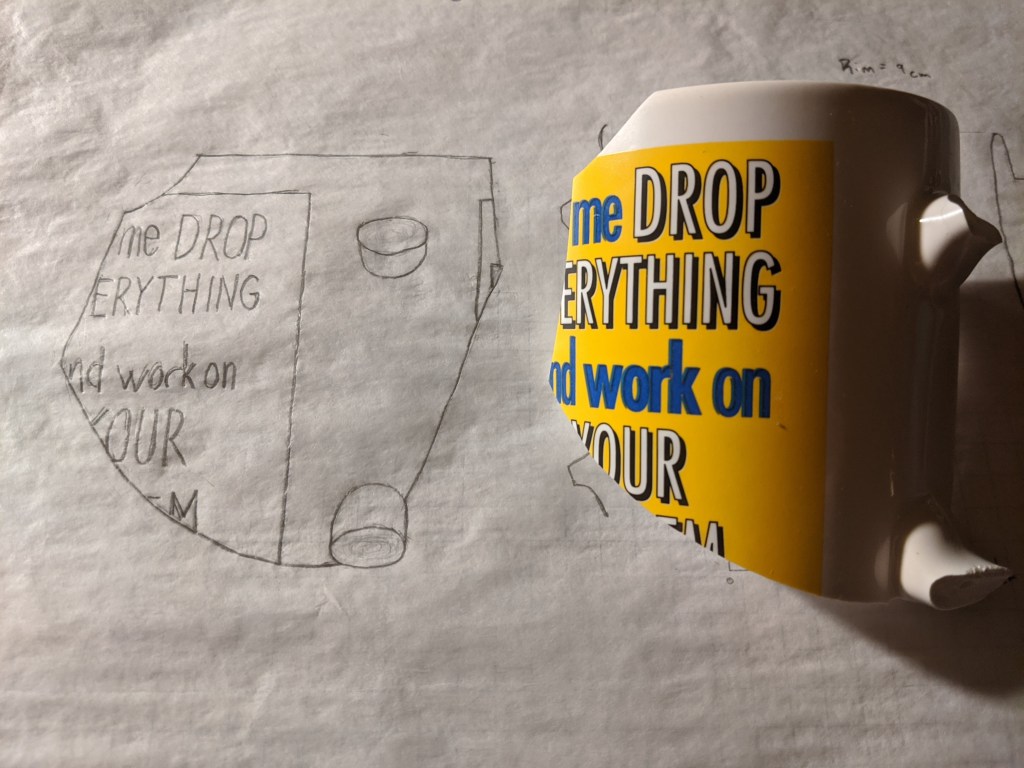
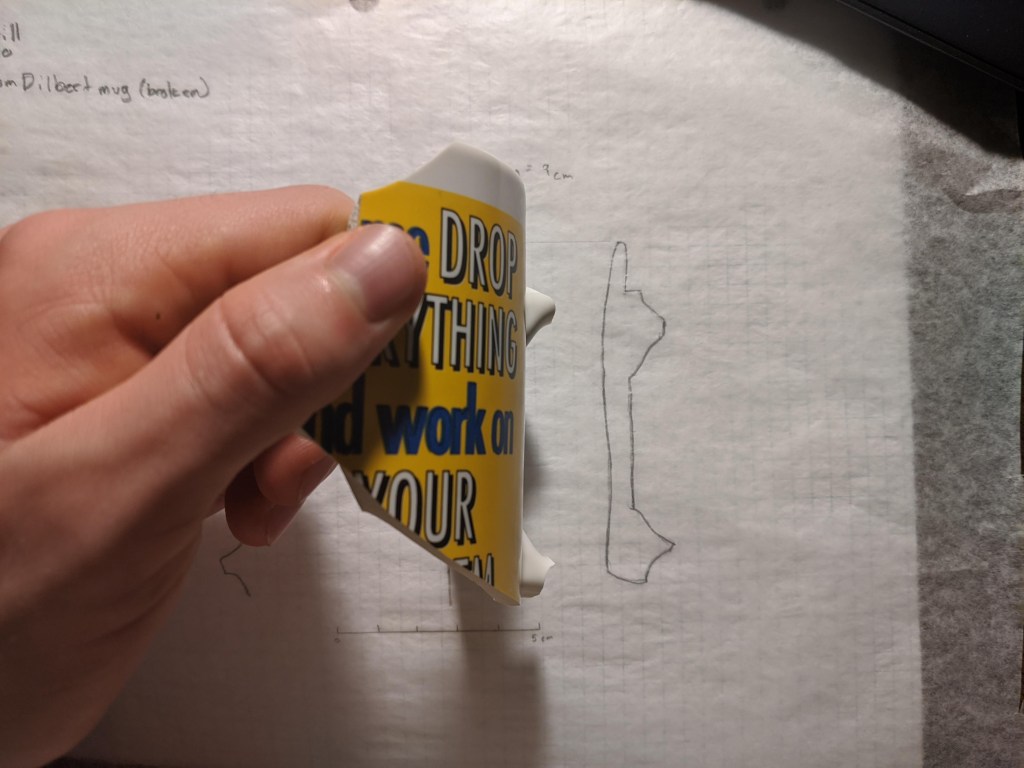
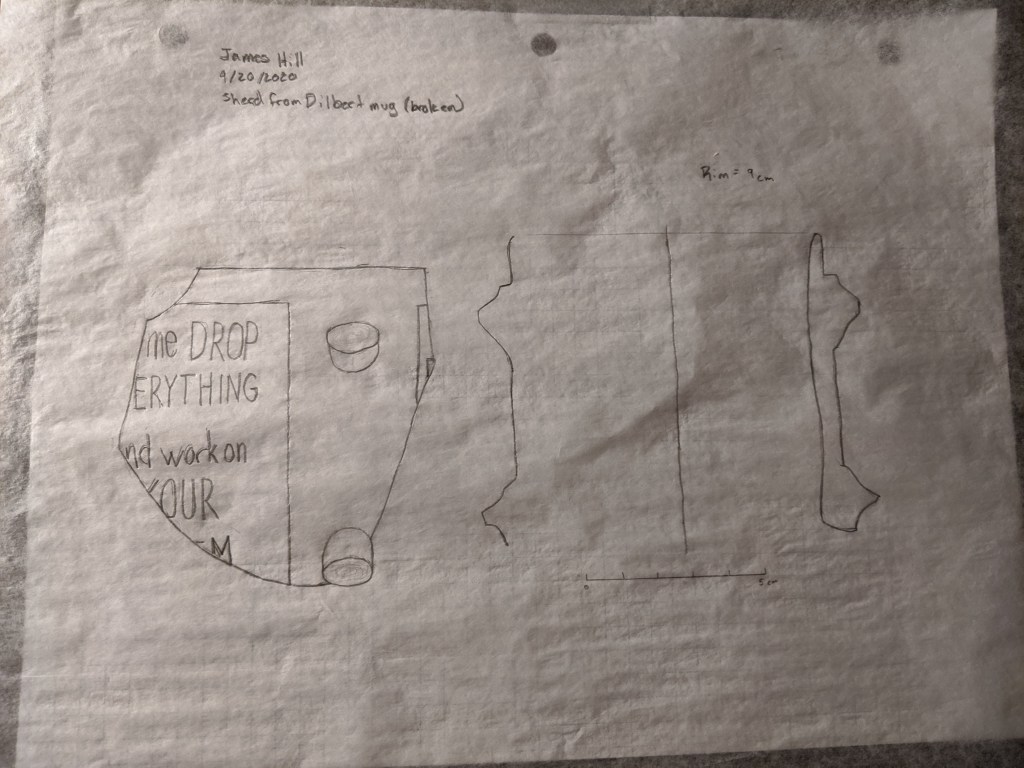
My archaeological drawing is complete and I’m really proud of it.  I had some trouble getting into it (my profile gauge absolutely refused to move), but once I found my footing, I had a lot of fun.  Not as much fun as breaking it, but that’s a high bar.  I think my favorite part was actually drawing the detail on the mug, which was harder than I expected it to be.  Writing is really easy until you have to do it larger and in a different style than you are used to. 

“Let me drop everything and work on your problem”

If I had to say what the biggest hurdle I had to go over was, it was that I sat down, all ready to do my drawing, and realized that we didn’t have any tracing paper like I expected.  Many improvisations (and a trip to the basement for tissue paper) were made and I don’t think it effected the final product very much, besides being a bit harder to photograph.  I think the most interesting part of the whole drawing process was when I went to do the mirror image. 

Turns out breaking the handle was important

I had chosen the mug sherd that had the handle remnants, because otherwise the mug was just straight up and down, no curves, which wouldn’t be very interesting to draw.  However, and some of you may have already realized my mistake far sooner than I did, this meant that my mirror image also included the handle stubs.  This poses a very interesting question for examining artifacts and sherds.  How can one tell if a feature on a part of an artifact is repeated elsewhere on it?  Just looking at my drawing, I could assume that there were once handles on both sides of the mug.  It makes me wonder how many drawings, or assumptions, have been made about artifacts, and thus their purpose and what that means about the culture they come from, that were incorrect, simply because there was some information missing and people assumed the answer.   

It really makes me think about my own archaeological residue.  How are future archaeologists (presumably without the ability to time travel) going to interpret my things that remain?  What mistakes will they make in assuming the use of an object.  I’m certain there are things that I find to be blindingly obvious as to their function, that someone in the future wouldn’t be able to understand.  And, taking that logic, it makes me even more certain that there are artifacts that we have that we are getting their use wildly incorrect.  The book mentioned that there are instances where the relationship of an exchange is more important than the object itself.  The book used Christmas gifts as an example.  How can we as archaeologists possibly begin to reconstruct or even guess at the sentimental value of certain objects we find? 

The Power of a Person

One thing that reading Archaeology Essentials made me think is tied to the question we all seemed to have after our meeting with Ally the other week:  Who has the right to write history? 

We all write history every day.  Telling a friend about something that happened to you.  Your family talking about your great great grandmother.  Writing a paper about some time period.  Every time we describe the past, we are influencing what some people think about that event.  Not to get to philosophical, but everything we do is defining history.  Every second that passes becomes a part of the millions of years of the history of the universe.  As soon as I write these words, they become a part of history.  I try not to think about that too hard. 

Historians and archaeologists are the more traditional example of writing history every day.  Whether it is in uncovering some new artifact, translating a new document, or simply connecting the dots to figure out a new theory about a civilization.  Even just telling someone about a part of history is defining that person’s perspective of the topic.  All of this impacts what people think about a given historical topic.  This can be problematic because everyone has their own biases, conscious or subconscious.  If everyone has their own beliefs and biases, who has the right to write history? 

Obviously, I’m not saying we just sack it all and never talk about the past.  I am a firm believer that those who do not learn from history are doomed to repeat it.  However, we do need to be careful.  We have examples of what happens when someone with biases – well, everyone has biases.  More problematic biases – writes history.  Look at the history of slavery, the Civil War, the Confederacy, that entire package, in the United States.  I grew up in Colorado so I had a decent education (being a swing state is fun I swear), but I’m sure one of my classmates who grew up in the South can talk about how they got a very different education.  We all know about the people who fly the Confederate flag and proudly declare that the Civil War was about states’ rights, not slavery.  This is because some people, to defend the questionable morality of the Confederacy, decided to shift the discussion away from slavery and say instead that they were just fighting government overreach.  This is, of course, wrong.  If the Civil War wasn’t about slavery then someone really ought to tell Confederacy that, as a number of their declarations of succession listed slavery as a cause.  But someone told another person that it was about states’ rights and that has become how some people see the history.   

Me at Mesa Verde this summer

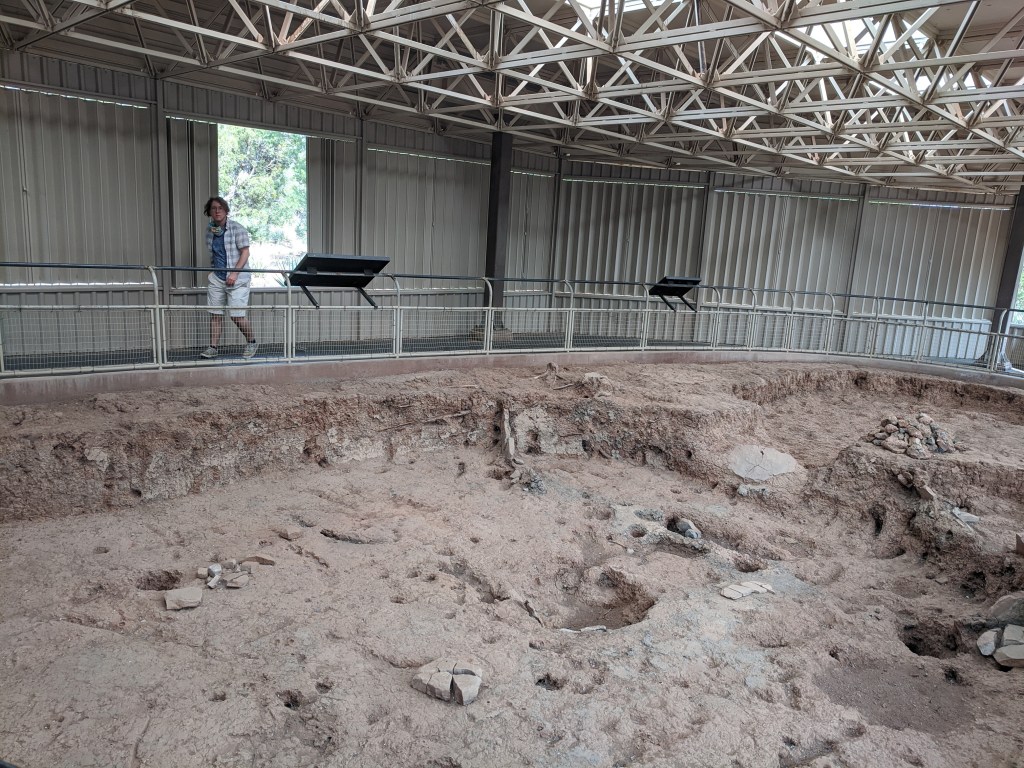
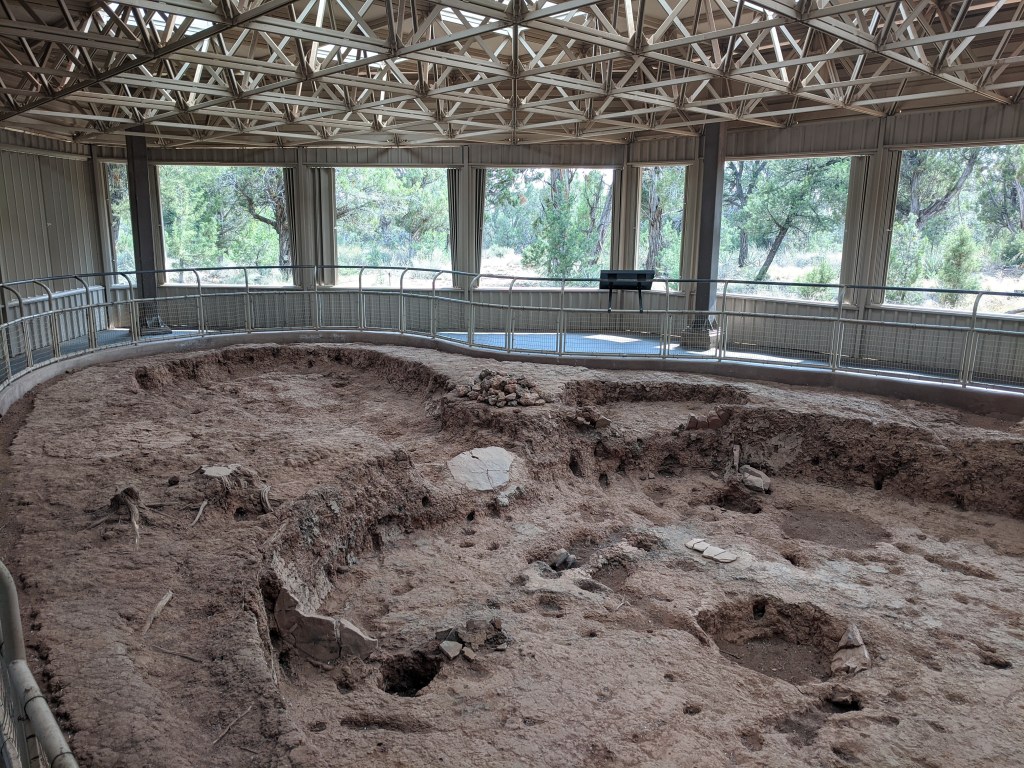
Even just the smallest things can be impactful.  A personal experience from a few years ago comes to mind.  I had just gotten done with attending an archaeological program just outside of Mesa Verde, where we learned a wide range about the Ancestral Puebloans.  After the program was over, my parents and I spent some time exploring the sites at Mesa Verde.  This included a tour of the non-cliff dwelling sites.  One site in particular was a great pithouse from around 600 AD.  The tour guide incorrectly said that it was the normal size for a pithouse, when in reality it was about double the regular size, thus it being “great”.  While this is a relatively minor mistake and impacts very few people, it is still an example of how small things can alter people’s view of history.   

Very much not the normal size of a pithouse

Again, I do not think that we should just ignore history all together.  However, I think we should think about the impacts of what we do and say.  We need to be aware of our biases, and the biases of works we are reading.   

Making History

Hello fellow destroyers of mugs, 

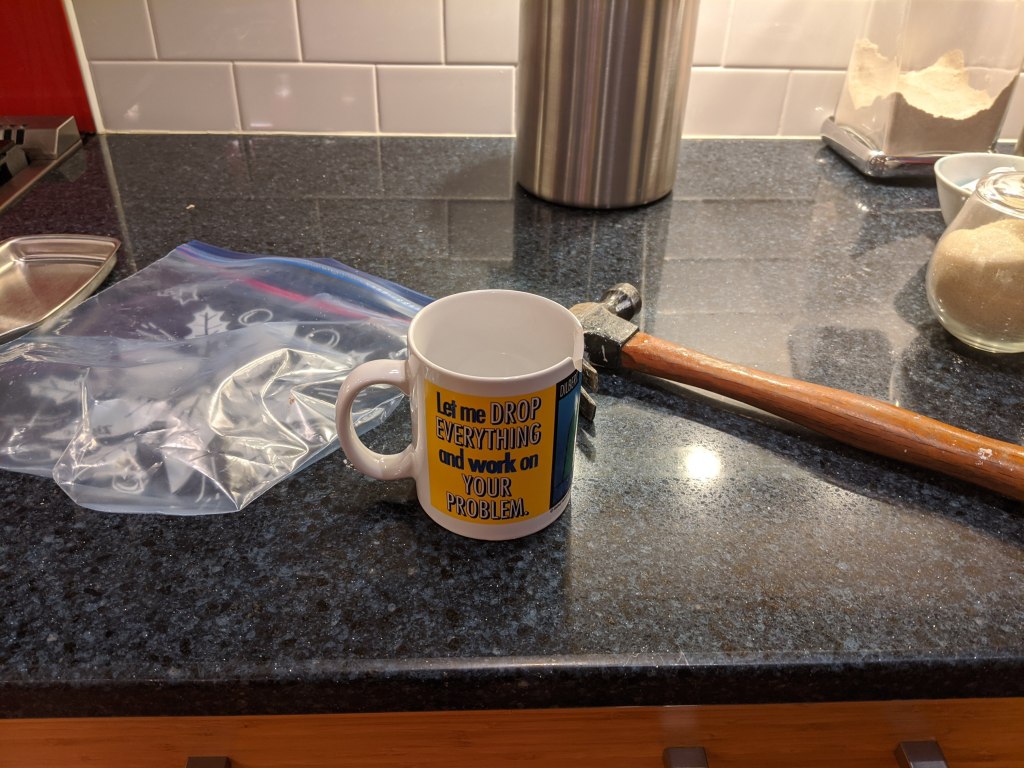
My archaeological illustration started off much the same as everyone else’s.  Because my family doesn’t always throw stuff away, I had a fine collection of chipped mugs to choose from.  I ended up with a mug that already had a chunk broken off because my parents felt it would be more of a challenge.  Lucky me.  The mug in question shows a Dilbert cartoon where the dog is saying “Let me drop everything and work on your problem.” 

The Setup

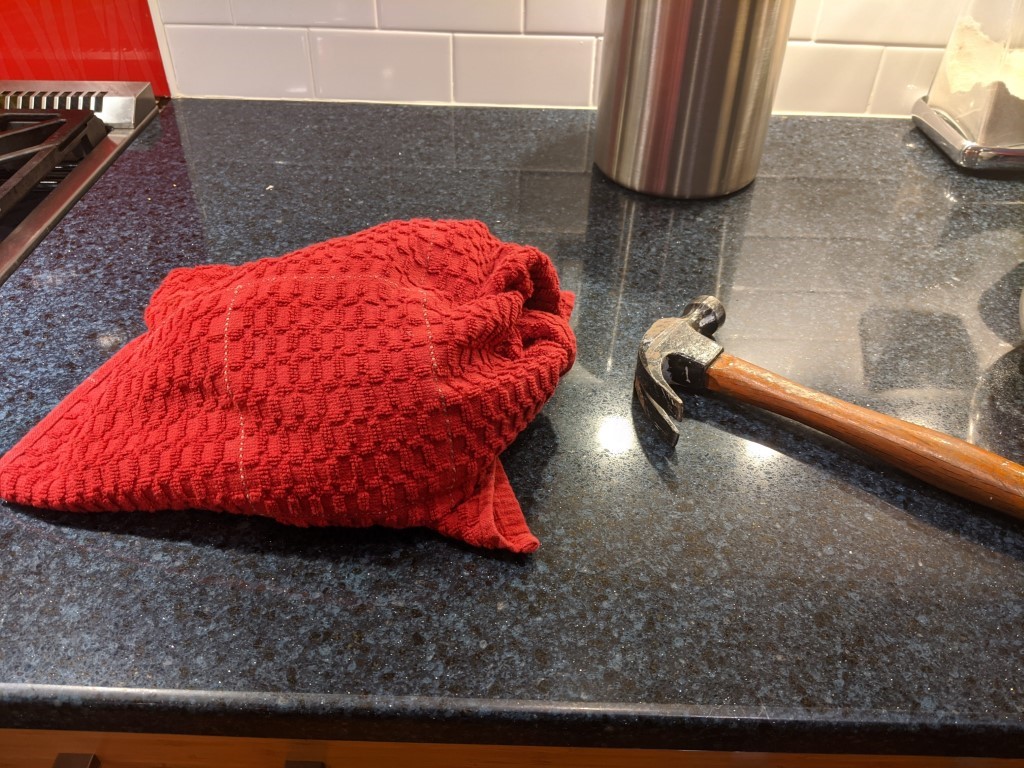
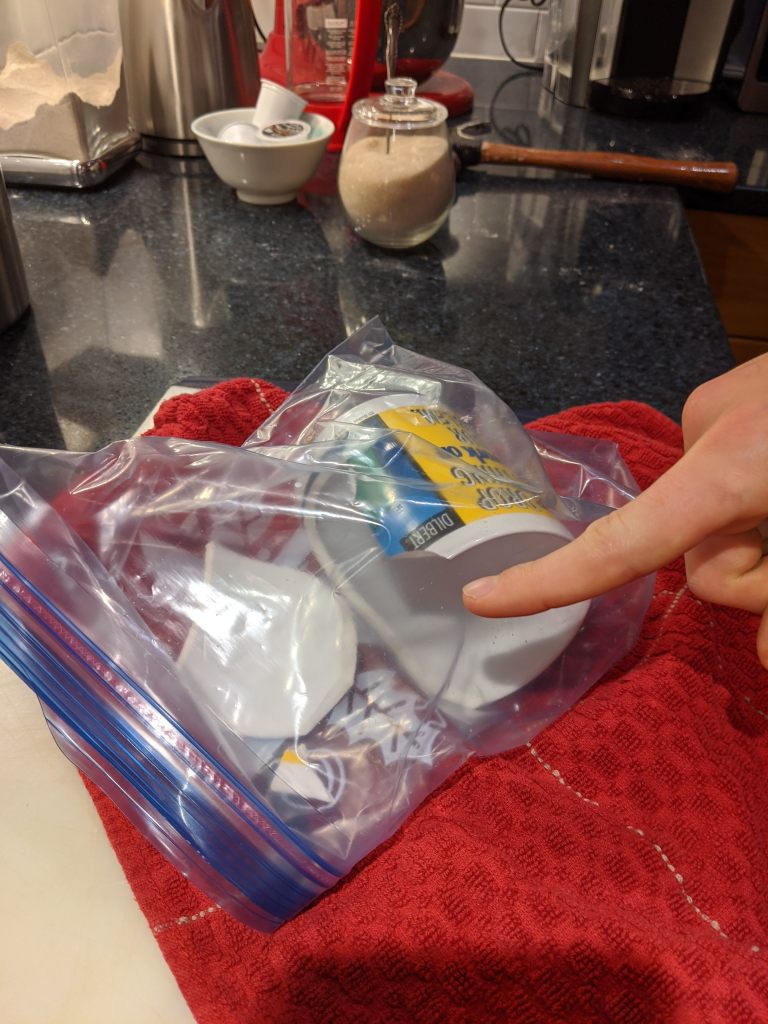
My parents, spoilers of fun that they are, also insisted on safely wrapping up the mug in a plastic bag and towel before I shattered it into as many pieces as I could.  A radical idea. 

Protective Measures

I was, however, disappointed at the surprising resilience of ceramic and its steadfast determination to break only at one point per hit.  Of course, it never shows this resilience when you accidentally break something, but such is the nature of the universe I guess. 

Obligatory “Pointing at an Object” Shot

After making sure to break the handle that had somehow remained intact, I was ready to begin the process of trying to draw my sherd.  I still have a lot of work to do on my drawing, but I think it is going well.  Although I am getting flashbacks to when I last took geometry with all the tracing paper. 

Like most of the class, I have some thoughts about what Ally said about how an illustrator is supposed to highlight what they think is most important.  My problem, that a lot of people have already brought up, is how this could lead to erasure of something the illustrator deemed unimportant, but is actually significant in some way.  It brings up too many reminders of how history has been whitewashed or sanitized in the past for me to be entirely comfortable with it.  Obviously, that isn’t what Ally was suggesting, but it does make me wonder what revelations might be lost to history as someone in the past – a historian, illustrator, publisher, whoever – decided that a detail was less important.  On the other hand, it makes me wonder what I have dismissed as less important that I should have paid more attention to. 

Welcome!

Hello!  I’m James Hill and this is my blog for Jody Valentine’s Archaeology and Society class, which I’m taking in the Fall of 2020.  I’ve taken another class with Jody before, thus the additional blog posts, which you can feel free to peruse or ignore at your leisure.  I’m a junior at Scripps, majoring in Classics.  I’m really excited for this class, as I hope to go into archaeology in the future.  I’ve done a few archaeology summer programs over the years, which is what has gotten me interested in it.   

My aims for this course overlap fairly well with the course aims.  Mainly, I hope to deepen my understanding of archaeology.  Naturally, ethics is a big part of that.  Speaking of ethics, as a classics major, I’ve been to the Getty Villa half a dozen times, so I’m excited for the section on that. 

Class Discussion Info

In browsing around classical texts, I have narrowed my project down to looking at Athena is Homer’s Odyssey.  Athena is a really interesting character throughout Greek myth, as a goddess with both a masculine and feminine roll and by acting very masculinity.  Even her birth sets her apart from other goddesses, as she sprung from Zeus’ head.  While this was because Zeus had swallowed his wife Metis (for prophecy reasons), Athena was born essentially only by Zeus, without the womanly part of childbirth.  In this way she is already separated from femininity.  Her roles also separate her, as they are both masculine, warfare, and feminine, craft.   

Athena’s interesting gender role is what I decided to focus on, specifically in the Odyssey.  Throughout the story she works to help bring Odysseus home to Ithaca and also helps Odysseus’ son, Telemachus, reach adulthood.  Within the story, she more often appears in disguise, similar to Odysseus.  More often than not, these disguises are male, throwing an interesting light on her own gender and its strangeness. 

For reading I have this article on how Athena and Penelope act as foils to Odysseus.  I think all of it is interesting but for the sake of brevity I would focus in on the Athena parts.  Secondly, and completely optional, I might recommend a quick spark notes reading of the Odyssey, just to help you understand what is going on if you haven’t already read it.