
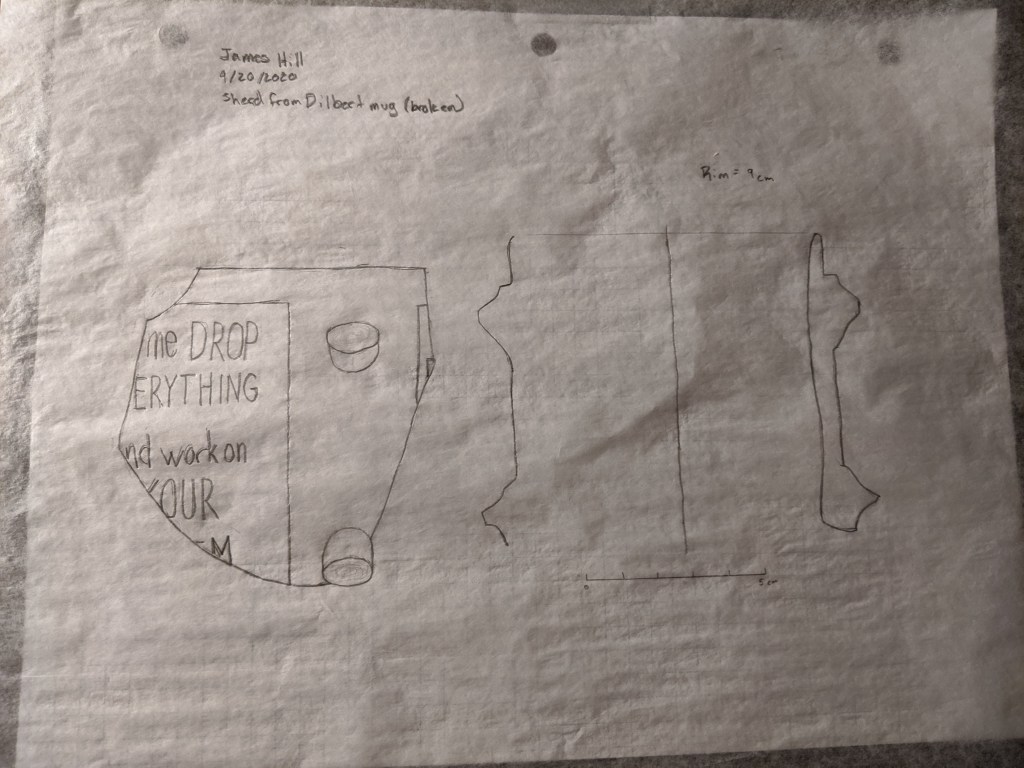
My archaeological drawing is complete and I’m really proud of it. I had some trouble getting into it (my profile gauge absolutely refused to move), but once I found my footing, I had a lot of fun. Not as much fun as breaking it, but that’s a high bar. I think my favorite part was actually drawing the detail on the mug, which was harder than I expected it to be. Writing is really easy until you have to do it larger and in a different style than you are used to.
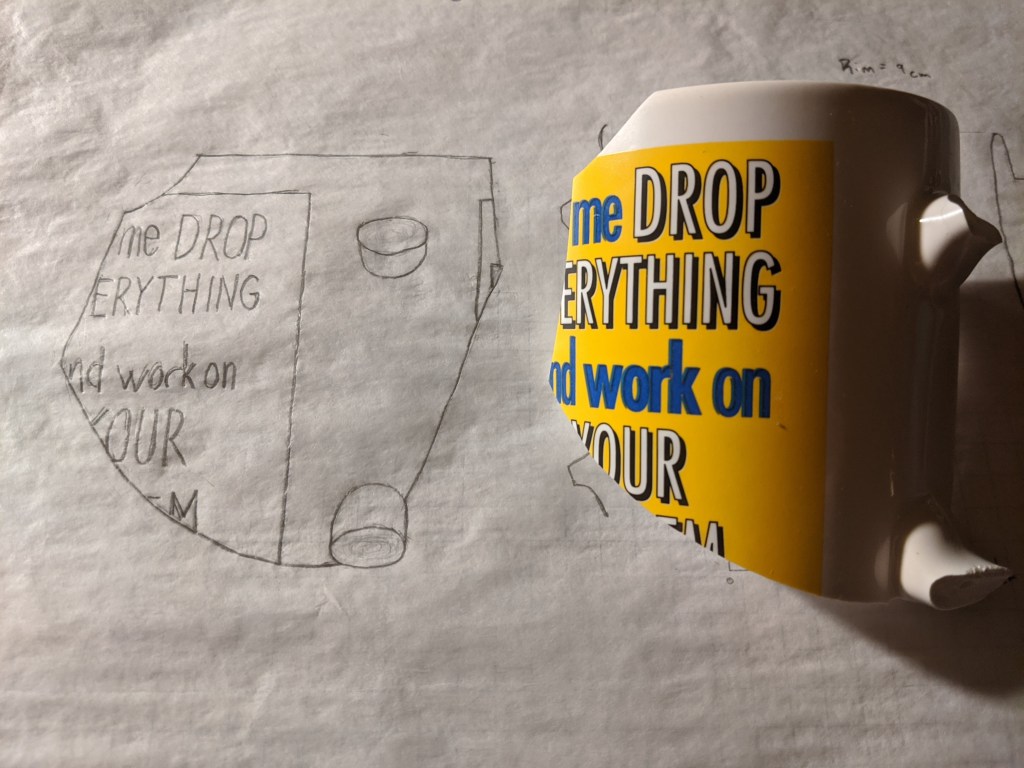
If I had to say what the biggest hurdle I had to go over was, it was that I sat down, all ready to do my drawing, and realized that we didn’t have any tracing paper like I expected. Many improvisations (and a trip to the basement for tissue paper) were made and I don’t think it effected the final product very much, besides being a bit harder to photograph. I think the most interesting part of the whole drawing process was when I went to do the mirror image.
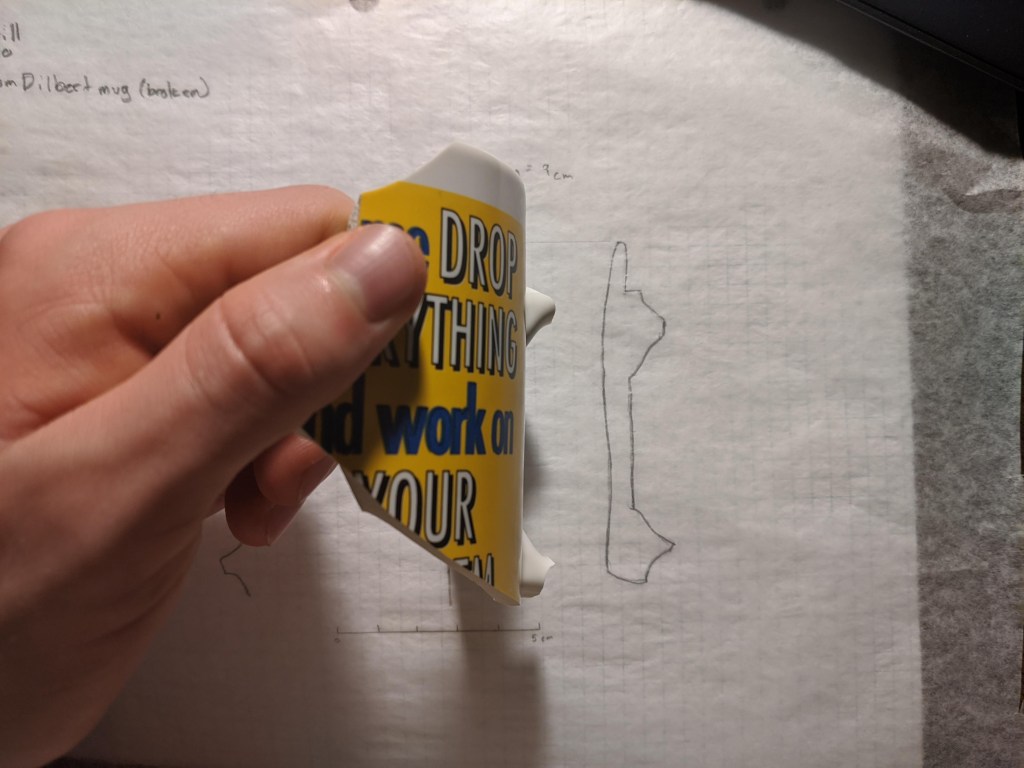
I had chosen the mug sherd that had the handle remnants, because otherwise the mug was just straight up and down, no curves, which wouldn’t be very interesting to draw. However, and some of you may have already realized my mistake far sooner than I did, this meant that my mirror image also included the handle stubs. This poses a very interesting question for examining artifacts and sherds. How can one tell if a feature on a part of an artifact is repeated elsewhere on it? Just looking at my drawing, I could assume that there were once handles on both sides of the mug. It makes me wonder how many drawings, or assumptions, have been made about artifacts, and thus their purpose and what that means about the culture they come from, that were incorrect, simply because there was some information missing and people assumed the answer.
It really makes me think about my own archaeological residue. How are future archaeologists (presumably without the ability to time travel) going to interpret my things that remain? What mistakes will they make in assuming the use of an object. I’m certain there are things that I find to be blindingly obvious as to their function, that someone in the future wouldn’t be able to understand. And, taking that logic, it makes me even more certain that there are artifacts that we have that we are getting their use wildly incorrect. The book mentioned that there are instances where the relationship of an exchange is more important than the object itself. The book used Christmas gifts as an example. How can we as archaeologists possibly begin to reconstruct or even guess at the sentimental value of certain objects we find?
 Transgression In Action
Dear James,
Your mug drawing came out really well and your choice in mug made me laugh. I also particularly resonated with your question of what archeologists think of our things that remain. Will they add in new meaning for objects that meant little to us or disregard things of extreme value? Would they take your mug at face value as simply a broken mug or turn it into a symbol of power? Perhaps, as you’ve mentioned they’ll apply a level of sentimentality that does not exist.
Also, I know you casually mentioned time travel but it led me to think about what we would do if we could travel to the distant past? Would leaving certain truths affect the way we operate culturally now? At times I feel as if we warp the past to justify our present and I guess it’s a question of whether or not we need the lie to survive.
Best,
Sydney
LikeLike